
Never-ending Stories
Something an 8-bit computer taught me about love and time.

It was 1990. Kuwait had been invaded by Iraq. Pete Sampras was the youngest ever to win the US Open at 19. Schwarzenegger’s Total Recall was the summer blockbuster. Ice Ice Baby1 and U Can’t Touch This2 were in heavy rotation on MTV.
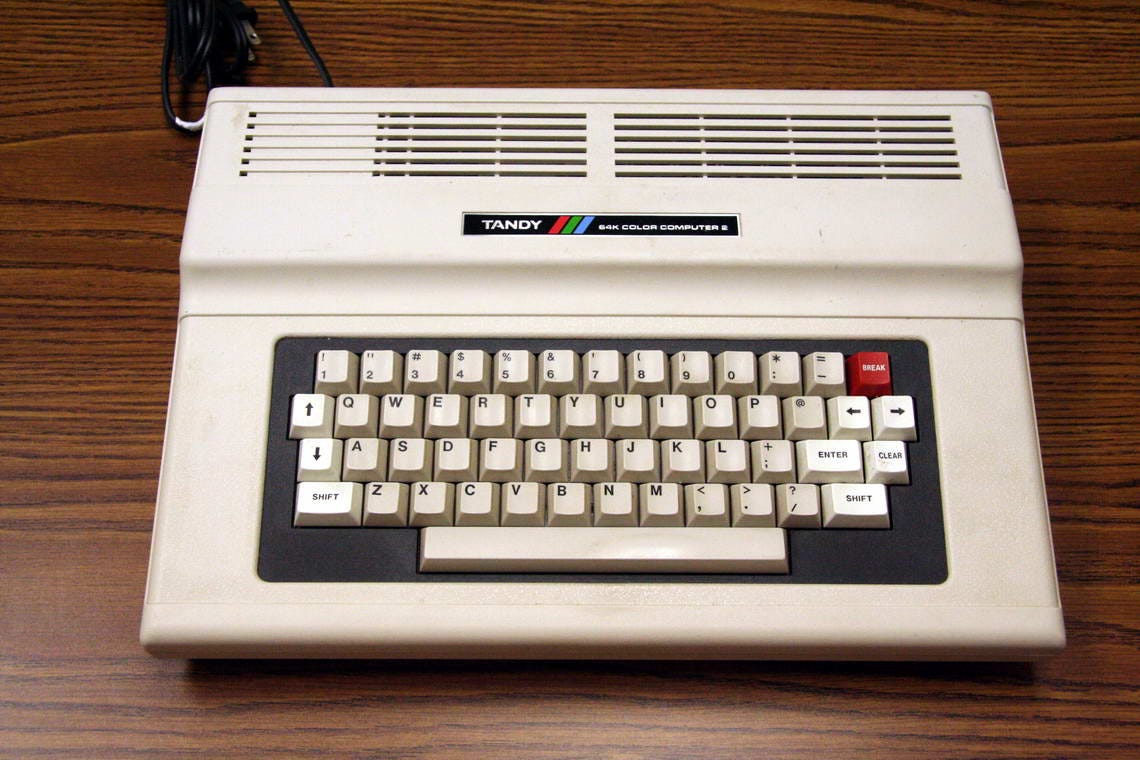
And I was 8, playing with the Tandy TRS-80 (affectionately called the “Trash 80”) my mom had gotten me for my birthday.

My room was the top floor “bonus room” of a tiny one-story house. It smelled older than it was, lending a musty respectability typical of an old library. I had an early Casio keyboard where I learned to play House of the Rising Sun by ear. I scribbled weird inventions in a large-ring spiral notebook (which I have kept), full of typical boyhood stuff: sketches of fantastical jet planes and wacky missiles they could launch with imagined guidance systems, bicycles with fancy shifters, cars with superpowers like James Bond’s.
And in the corner next to the window overlooking the street was my first personal computer, at a time when very few people had one. It was the best gift ever.
There was no hard drive, only a huge 5¼ inch floppy disk drive attached via an equally monstrous cartridge3. The screen only displayed one color: green. Not the pleasant, verdant kind you find in manicured fairways or blanketing idyllic parks, but a vile, synthetic green so unnatural that it offends even your sense of smell.
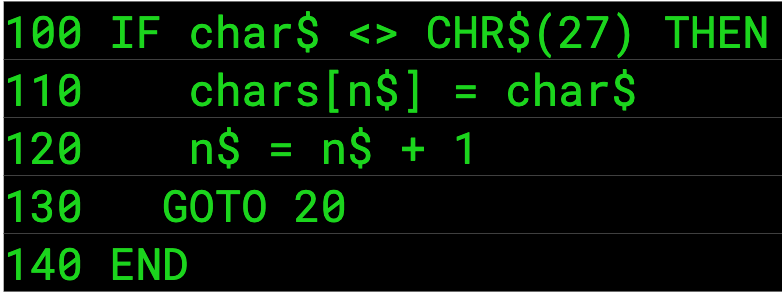
I spent hours teaching myself to program QBASIC from a book that was little more than a language specification. Back then, the marketing was honest. It really was basic! No fun exercises. No witty exposition. It’s like the book was treating you like a computer.
I remember the first real program I wrote: a very simple word processor. It literally just saved the words you typed. I even remember my first bug. I was so proud of my program, I asked my mom to write a letter using it, and she did! A real letter she actually needed to send. But I hadn’t tested it beyond a couple sentences. And when that one variable (a byte array) I was appending all the characters to hit the magic number of One Too Many, it crashed. Before there was a Microsoft Blue Screen of Death, there was the Black Screen of Failure.
My mom was pissed. She had been writing for 10 minutes. Now, whenever I feel lazy about testing my code for bugs (I now write code for a living), I remember how quickly pride can turn to shame. They say pain is the best teacher, but your mother’s wrath must be a close second.
Even though I’m the protagonist of the story, and the TRS-80 is a magical talisman in a quest for computational mastery, the real hero of the epic is my mom. How would a divorced nurse have the foresight to buy their elementary-aged kid a computer in 1990?? The only thing she’s ever programmed herself was a VCR.
The TRS-80 was the best gift for me because it was suited to me, because it was actually a gift of love in the form of a box full of silicon and integrated circuits. But neither I nor anyone else realized (or could realize) that until much later. Its effect is more than how I felt at the time; it’s also how it changed me and changes me.
Then and now and then again
It’s always like this. Being human, I mean. Our experiences aren’t static facts, like bits written to an immutable stone tablet. Well, they are in that they happened and can’t physically be changed. But what they mean to us unfolds over time. It’s like the past is still real, continuously influencing the present through our consciousness (and subconsciousness) of it. The moment is both the seed and the fruit.
If my past is real, and its meaning and effect can shift and evolve like any other living thing, then so would everyone else’s, including those that have already stopped existing in this life. In the Eastern Orthodox Church, during memorial services, we sing “May your memory be eternal” for those that have departed. And because we do, they are.
What kindness have you been given that you can bring into the present? To honor or resurrect the giver through your own actions inspired by their memory?
What kindness can you give today, small or simple it may be, that can reverberate across time and space as an eternal echo of love?
“A new commandment I give to you, that you love one another; as I have loved you, that you also love one another.”
“Word to your mother”
4.5 minutes and not a single curse word.
The modern semi-permanent hard drive stores hundreds of gigabytes (giga=billion), but this took decades to achieve. The floppy disk was quite literally a bendable magnetic disk in a plastic sleeve that you could keep in a file folder (https://en.wikipedia.org/wiki/Floppy_disk). You needed to easily swap them because they only held 1.44 megabytes (mega=million), or a hundred million times less. For perspective, that’s comparable to the size difference between the sun (which is 100 Earths across) and a grain of sand.